Your Response is a Choice
 Jen Drago

Are you the type of person who learns from your mistakes? Or clumsily repeats them over and over again, expecting a different result?
Are you the type of person who learns from your mistakes? Or clumsily repeats them over and over again, expecting a different result? We all suffer from the latter, even when we try hard not to repeat mistakes. But, let’s face it. Our worlds move fast and we often make decisions on autopilot while operating in a multi-tasking environment with constant distractions bombarding us. It can be downright difficult to make our decisions more conscious or thoughtful. But I would argue that your physical and emotional health depends on it!
Viktor Frankl, Austrian neurologist, psychiatrist and Holocaust survivor who wrote Man’s Search for Meaning, says:
“Between stimulus and response there is a space. In that space is our power to choose our response. In our response lies our growth and our freedom.”
During Frankl’s time in a concentration camp, he found that those around him who did not lose their sense of purpose and meaning in life were able to survive much longer than those who did not.
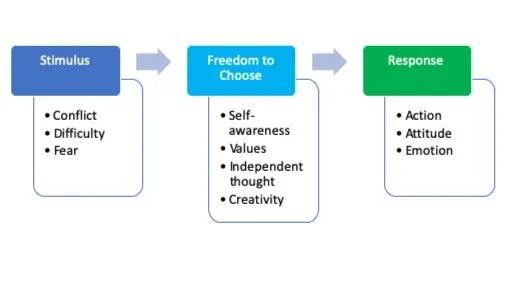
Let’s think of another common example. A co-worker makes a flippant comment in a meeting that could be perceived as disparaging to you or your work. You might respond in a number of ways based on your interpretation of that act. Again, if you thought the comment was intended to insult you or make you look bad, you might hold on to silent anger and resentment, and wallow in your own fuming thoughts. You might also outwardly react in front of other team members which may make you look like a hot head or, if your interpretation of the situation was incorrect, may make you look like an overly-sensitive bitch. On the other hand, if you choose to perceive a different interpretation of the situation, you might realize that your co-worker spoke without thinking or was not really intending to throw shade. And, therefore, you just might give them the benefit of the doubt without reacting negatively.
You have the ultimate power to choose how you perceive a situation, how you allow a situation to affect you and then ultimately how you react to the situation. Retaining that power and making choices that are positive for your physical and emotional health allows you to be in complete control of your life and to not be unduly influenced by others’ actions. I find the thought of that level of self-control to be freeing and fulfilling because, even if my co-worker was intentionally trying to throw me or my team under the bus because she likes to make herself feel taller by pulling people down, I know that she cannot affect me, dampen my positive mindset or arouse a reaction in me. I can calmly and professionally respond to her in the meeting and then figuratively flick her off my sleeve like a flea. I remain calm and strong in the face of adversity.
Are you the type of person who spends the day swimming in negativity because of how you perceive your environment and the actions of others? Imagine how this affects your autonomic nervous system – the part of your body that functions to keep you breathing and alive. If you are constantly agitated at the world around you and “what people do to you,” you will be in “fight or flight mode.” Your heart will beat faster, your respiration rate will increase, your muscles will tense, your blood pressure will rise, you may not be able to sleep restfully. You will be expending useful energy in a non-useful manner, causing your body undue stress. On the flip side of this example, if you choose different perceptions of your environment and what happens to you each day, you will remain calmer and your body will not be in a heightened state, ready to strike or flee the situation.
Try to be mindful of your mindset for the next three days as you encounter situations within your environment. Are you able to make conscious decisions in the “freedom period”? Can you control the way you respond and how your body reacts to the situation as a result of your controlled response?
Having a positive mindset and choosing how we react to stimuli in our environment is powerful. These choices affect our physical health, our emotional health, the quality of our relationships and will ultimately determine our longevity and satisfaction with our lives. I urge you to make the right choices today! Your body will thank you for it.
Categories: : Leadership, Mindset