Why Your Business Needs a Vision Narrative
 Jen Drago
Learn what a vision narrative is and how it can help your organization maintain its strategic focus.
Prefer to watch the video instead? Click here.
Have you ever heard of a vision narrative? Today, I'm going to tell you what it is, why your business needs one and how to create one.
Hi, I'm Jennifer Drago, founder of Peak to Profit, where we help solopreneurs grow their business through a laser-focused strategy known as the PEAK formula.
What is a Vision Narrative?
You may have heard of a vision statement. Traditionally, it's paired with a mission statement and it's an aspirational sentence that's supposed to describe the future state of the company. The problem is, is that it's only one sentence. It's not very descriptive. It generally does not give much information about where the organization is headed.
Instead, I advocate to create a vision narrative, also known as a "portrait of the organization in the future". It's a series of 6-10 statements that descriptively portray the company and attributes of the company and its clients in the future. Michael Hyatt, well known business author, wrote this book called "The Vision Driven Leader," and in it he calls it a vision script.
Why Do You Need a Vision Narrative?
A vision narrative or vision script is aspirational. It's attractive. It's intended to be inspirational both to you, your leadership team, your front-line staff, your board members, anybody that you will use
it with to rally around this vision of the future. It's a description of the destination that your organization hopes to reach in a period of generally 3-5 years. You pick one timeframe, generally three years or five years, depending on your industry.
It's a portrait of your moonshot -- where you want to go. And if nobody has that vision, if you're not casting that vision as the leader of the organization, no one can follow you. No one will know how to get there. Even you won't know how to get there because you haven't clearly articulated where it is you want your organization to go.
And you know what they say: If you don't know where you're going, any path will get you there.
Creating a vision narrative is absolutely the very first step that I have any organization take when they're starting a strategic planning process. Andy Stanley says, "Direction, not intention, determines your destination." You must have the destination in mind first and then you, as the leader of the organization, direct the organization and its assets toward that destination.
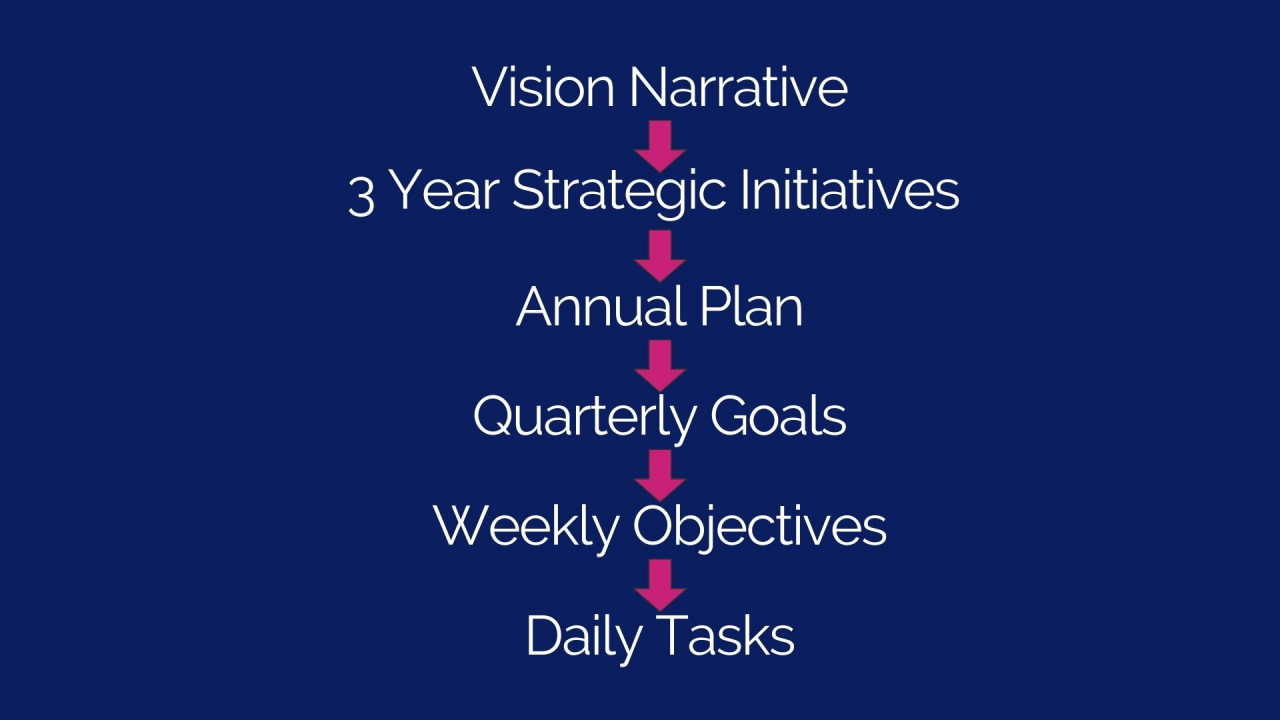
In fact, as I mentioned, a vision narrative is the very beginning of any planning process and will allow you to then create an annual plan and goals that are strategic and move the organization in that direction. We start generally with a vision which is again, usually three years, sometimes a little bit longer.
We create annual plans from that vision. We then create quarterly goals, weekly objectives and daily tasks. You can see how it all cascades, but it has to start with that vision narrative.
How Do You Create a Vision Narrative?
Let’s learn how to create a vision narrative. First, you want to gather your team. Generally, you don't want to do this by yourself, even if you are a solopreneur. Do you have a business advisor who can sit with you? Is your partner, someone who knows where you want the organization to head and can be an extra set of eyes and voice for the business. You don't want to do it by yourself because sometimes as entrepreneurs, we have self-doubt that creeps in and we wonder if we can really make it as far as we want to. We want some people to push us a little bit. That's why it's better to do it with more than one person.
Next you want to pick the time frame for your destination: three years, four years, five years. I've done it as short as two years for an organization that had a really aggressive growth plan. I would say three years is probably most common.
Don’t get hung up on this. You can always revise it in a time period before that if you grow faster than you even projected that you might, but three years tends to be good for most organizations to have a time horizon for your narrative.
Third, you want to ask questions that lead to descriptive statements of what your organization will look like at that future point. So, if we're looking out three years from now and I'm creating this video in October 2021, I'm going to start with the phrase, "by October of 2024, <my organization> will:" Then I will start to list, in bullet form, some of the statements that answer these questions:
- Who will we be serving and how many clients will we be serving by that time period?
- What will be our sales numbers or revenue numbers?
- How will our products change? Will we have or do we have one product now, but we might have a series of products, maybe we'll have physical in addition to digital products, by that three-year horizon?
- How will our geographic area change?
- What will the measurable impact be that we have?
- How will our team need to change during that period in order to make all that growth happen?
- How many team members will we need to have?
- Will we need to fill key leadership positions that we don't have on board today?
- And what other ways would we use to describe the growth and the change of the organization in the future?
Remember to use descriptive terms, thinking as though we're speaking in October of 2024 or whatever time horizon you're looking at when you're doing this.
A Sample Vision Narrative
I'm going to share a vision narrative of a local nonprofit organization that I worked with and their Board brainstormed, after describing the challenges that it faced and things that it wanted to overcome in the period of this vision narrative, which is a five-year period.
"In 2026, <this organization>:
- Serves twice as many clients through enhanced awareness and increased hours of operation, Monday through Saturday.
- Has completed its 2021-22 capital campaign and successfully expanded its building, providing 3000 square feet of additional space.
- Is led by paid staff members whose positions are funded through annual contributions, including an executive director, volunteer coordinator and a marketing/fundraising manager.
- Benefits from a strong core of volunteers who have doubled the number since 2021, each committed to providing two or more shifts per month.
- Benefits from a strong and engaged board of directors with diverse experience and backgrounds.
- Enjoys a waiting list of community leaders and influencers who desire to join its Board.
- Is well-known in the community for its signature fundraising event, which nets over $100,000 per year and introduces hundreds of new prospective donors to the organization's mission.
- Has built a consistent and reliable stream of annual donations, including representation in the budgets of the core cities served by the organization.
- Actively pursues partnerships and service enhancements such as delivery of its products.
That's an example of nine statements that describe where that organization is headed and what it will look like five years from now.
Learn More
Do you want to know how you can create a vision narrative for your own organization? Click here for a free step-by-step guide to creating your own vision narrative.
Do you want to know what comes next after you create the portrait of your organization's future? Subscribe to our weekly newsletter at peaktoprofit.com, and you will learn all the aspects of the PEAK formula, which is planning, execution, analysis and knowledge.
Categories: : Leadership, Vision